Turtle Face
In brief, like many PC China volunteers I have been doing a combination of traveling and working for the past month and a half, not once returning to Wanzhou. In that time I went bouldering in Western Sichuan, visited a student in his village in southern Chongqing, taught Chongqing middles school teachers how to teach differently, went to Shanghai, visited another student at his home in Chongqing city, and led EcoCamp with a host of outstanding volunteers. This post will only cover the first 1.5 weeks of my summer.
Rain Gods
In June, my site mate, Gabby and I made plans to find the legendary boulders at Karakul Lake a few hours outside of Kashgar, Xinjiang. We wanted remoteness, new culture, camping, mountains, and boulders. But, our plans were thwarted when PC travel to Xinjiang Province was barred due to the recent attacks in the provincial capital, Urumqi. Last winter I met a professional climber in Chengdu named Mike Dobie. He has been developing trad climbing in Li Ming, Yunnan for a handful of years and said that he had a bouldering development in Daocheng, Western Sichuan. He added that he didn't think the Daocheng development would ever catch because of its extreme proximity to any major city, the poor roads and infrastructure leading out there, and the day or two that it takes for your body to get acclimated. Daocheng was the perfect substitute.
Gabby's problem on the warm up boulder
Traveling to DaoCheng:
Getting to Daocheng (稻城) and back is a whole trip in itself. Our plan was to take a 9 hour bus from Chengdu to Kangding (康定). Stay the night in Kangding. And then a bus in the morning to Daocheng, because there is only one bus a day from Kangding to Daocheng and it leaves super early in the morning.

We rented a minivan with some young Chinese urbanites we met at our hostel. In Chinese minivans for hire are called, Bread Car
There are only a few buses a day from Chengdu to Kangding and they leave between 7am from Xinanmen Bus Station (西南们车站). To ensure that you get a ticket, you should try to buy your tickets the day before, probably sometime in the afternoon. A nice and affordable hostel, Traffic Inn, is around the corner from the bus station if you need to stay the night.
We got to Kangding around dinner time. The tickets for the next day were sold out so we resorted to renting a van. It was less than 200kuai (30USD) per person because we shared the van with some Chinese people. Our hostel arranged it for us. We did not book our hostel in Kangding in advance. With the increase of tourism in Western Sichuan, I recommend you book one in advance. In the morning we hopped in a van headed for Daocheng. During the 12 hour ride we experienced just about all four seasons and climates at elevations ranging from 8000 to 15600 feet. I wouldn't be surprised if the Kangding-Daocheng ride becomes listed as one of the most beautiful car trips in the world. One thing that should be noted is that the roads are very narrow, often broken or destroyed due to erosion and the pavement regularly freezing and thawing, also about a third of the road is dirt, so bring a plastic bag even if you don't get motion sickness.
Pitstops Between Chengdu and DaoCheng:

Since there are only two major highways connecting Chengdu to Western Sichuan, year round you will see Chinese bike trekkers riding through to Tibet. One pitstop at 14600ft
Squares of colored paper with prayers scrawled are thrown into the wind like prayer flags flying
Herder in skinny jeans pulls horse across highway to be watered. Our driver stopped so he could wash the minivan
After breaking through the extremely dense and floral mountains of the Sichuan Basin the geography instantly changes to high altitude pasture. The herders here live in tents and yaks usually graze unperturbed
Some folks we met driving from Gansu Province, while we were stopped for road construction
Biking and Exploring in Daocheng:
Just before reaching Daocheng it started snowing. Driving the high mountain passes on narrow slick roads was terrifying. We arrived at dusk.

Once your reach Daocheng it instantly feels like you have left China. The people are mostly ethnic Tibetans. They are tall and their skin is brown. The men dress like cowboys: long matted hair, gold teeth, and cowboy hats, only each has his own string of prayer beads. The women dress in the long traditional black garb, covering almost every inch of skin. If it were not for the modern face mask to protect from the dust and sun, you would think they were transported from 1870's American wild west, for their big bonnet hats create a complete image. Above is the traditional Tibetan yak's butter tea. We followed our Chinese van friends to their hostel and shared a room.
The next morning Gabby and I rented bikes. Our goal was to find Rubuchaka Village (茹布查卡). Dobie's bouldering guide marks all of its developments in the valley. Prayer slabs are placed to face the sky
Urban pigs
We ended up riding the wrong way, and none of the locals seems to have heard of the place. No a bad place to get lost
A mute ice cream man rides his bike through the valley
We found the valley!! A women walking on the road led us there. The valley is very remote and a little difficult to find if not driven

Turns out there numerous families living in the village have home stay capabilities. Gabby and I arranged a deal where we pay 80kuai (12USD) per day, which includes a bed, three meals, and one hot spring bath. We didn't know this until we got to Rubuchaka, but the whole village recently capitalized on the hot springs running through it. Despite the hot springs and the beauty of Rubuchaka, there are still few visitors. While making a deal with the family (some pictured above, can also see hats), it was pretty clear that they had never had anybody stay there before for more than one night, or ever. They are amazing people. We recommend that you stay at their establishment. Their house is fairly big, and located in the back on the village. They have eight beds to rent. Most of their food is vegetable and noodle (dough) based and it is so good. They also have a steady supply of Tibetan Yak's butter tea, bread, and Yak cheese.


Prayers are chiseled into random rocks throughout the valley. There are two resorts in the valley that flopped (right). It is nice to see that the yaks are taking back the land.
Bouldering Area Five:
Gabby approaching Area Five
Dobie broke Rubuchaka Valley into five bouldering areas. All five areas surround the village at the bottom of the valley.
We didn't bring bouldering pads on this hike so we did more exploring of the massive rock formations and caves than bouldering. We found some amazing things.
Me warming up

Our first problem, we call it "Crown." It is located in the back of the Area. It is a long traverse up the edges. V2.
Area One:
I put up an easy V0 in the morning.
My problem is on the left above the pads. Gabby sent one of the problems set is the guide.
If you walk 15 minutes of the ravine in Area One you will find our next problem, "Turtle Face." V2.


There is endless amounts of bouldering at Rubuchaka. But there are a few things to be aware of. First is that if you are camping or hiking there is almost no cover from the weather. There are thunderstorms and snowstorms, but I think the sun is the most dangerous. Daocheng sits above 14000 feet. With clear skys, which are common, sunshine is less romantic, and more of a powerful radiation at that point. If you are here in the summer you need to bring a hat, long sleeved shirt, pants, gloves (seriously), and lots of sunscreen. We found that carrying an umbrella up there paid off. A benefit of the elevation is that water evaporates so quickly that even in the crazy sun you never really sweat. Oh, and it took me about two full days to get fully acclimated.
We finished our hike at Castle Peak
An ariel view of Rubuchaka Village. The road is on the right and our home stay house is on the far left
Bouldering, Camping, and Friends:
Evan, Kayla (both PCVs), and Nina (grad student is Hong Kong) showed up on the third day. We found this great bouldering in the field behind our inn to warm up on.
Nina and baby cows
I believe Dobie's problem on this boulder is called the "Candy Cane Traverse," which traverses from left to right. Gabby and I put up a problem going straight up from where I am sitting called, "Rain Gods," because of the flash hail storm that hit just before we were about to send it. V2.
Gabby and Kayla after surviving the hail storm
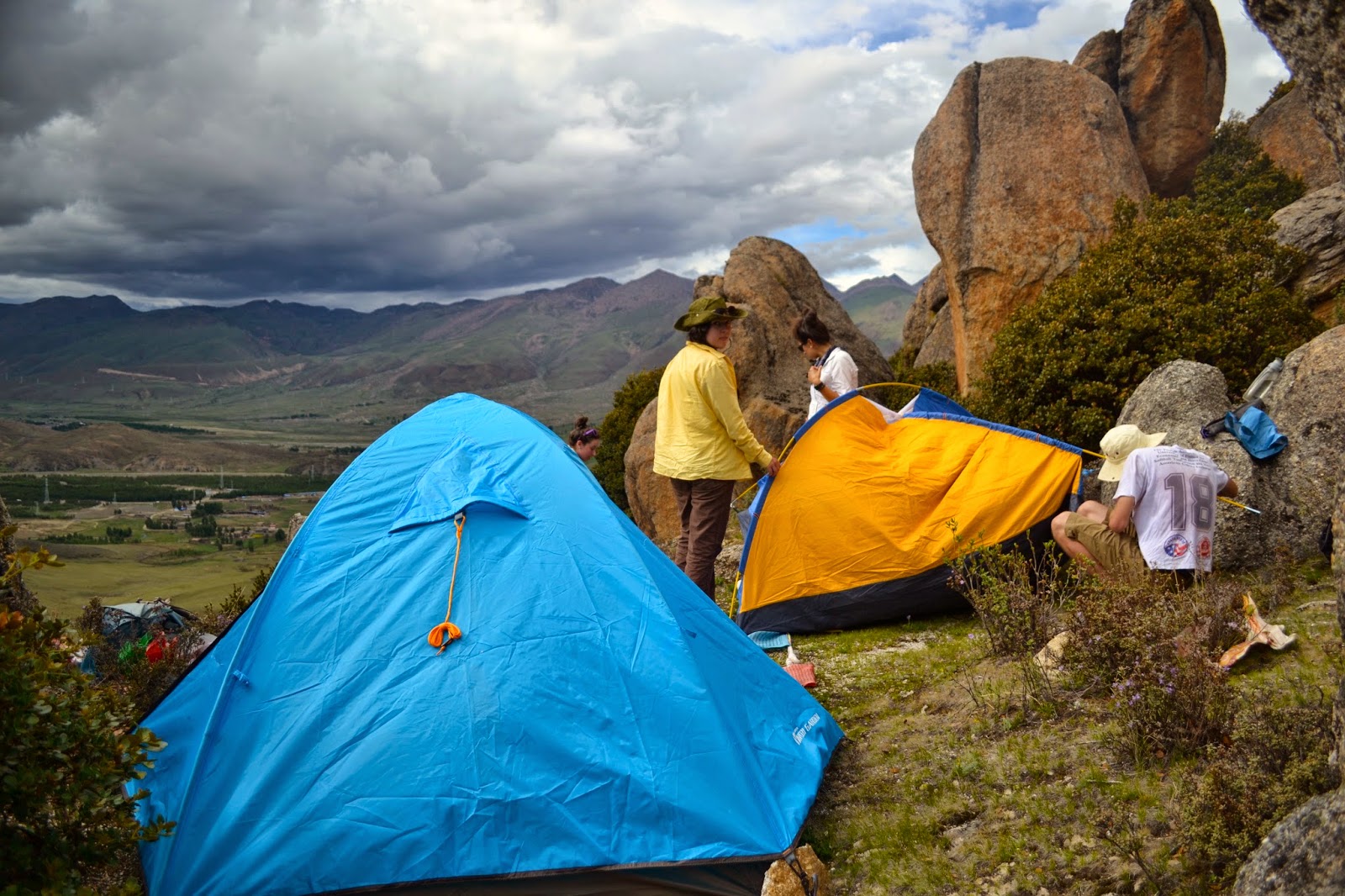
We hiked back to Castle Peak to camp. Our plan was to boulder, camp, and cook. So we had to carry all of these things up to the top of the mountain. We left the rest of our stuff at the inn for the night. I got fire wood from the inn for free. To carry it to the top I wedged it in between my bouldering pads. Even tough I had five large pieces of fire wood, I think I had the lightest pack. The others had to carry food, water, and gear. You can buy prepackaged food, fresh food, flashlights, and other supplies in Daocheng.
We hadn't thought of how we were going to cut the firewood until we got to the top of the mountain. We resorted to throwing big rocks at it
When big rocks didn't work we tried to hack at it with small rocks. And then we discovered leverage, but weren't strong enough :( so we lit our fire in defeat. But, starting a fire at 14000 feet is no simple task. Until we put our five college diplomas together and came up with a plan to divert the wind, I actually though we were going to run out of matches and not eat
Victory. I spent almost all of my time tending the fire and watching the food, probably an hour, and I am very proud of myself for it, because the fire never died once.
We had baked potatoes, corn, apples, peanuts, and other things. BTW, don't mix Yak cheese and potatoes...
Night. Slow Shutter. Fire
In the morning we tried to put up some problems. The rock Gabby is on was too sharp to climb
A problem I put up on a random boulder in Area One
Women walks her cattle back to Rubuchaka
There is a perpetually spinning prayer wheel on the inside of the structure on the right. The wheel is powered by a stream flowing below it
Last Days at Rubuchaka:
Dyno...
...in the morning
Gabby putting up a great problem on the left side of the warm up boulder in the backyard of our inn. Starting position
In the afternoon Gabby and I took the others to a crazy boulder cave we found in Area One. Three new Rubuchakan friends decided to follow us the whole day out
Fearless
Climbing over rocks can be difficult with out hands
All of the boulders that set in place to create this big and fully roofed cavern were once suspended in ice. By chance and magic all of the boulders were magically aligned. Definitely one of the coolest natural things I have ever seen.
On our way back to the inn
Doing laundry in the hot springs
On the last day we biked out to a temple that Gabby and I had seen from the road we got lost on. We asked this family for directions to the temple which you could see in the mountains from this point, but alas, nothing. They speak the Zang (Tibetan) dialect in many parts of western Sichuan. Earlier we were told that every town has its own version of Zang dialect. That white guy in the back is named Peter. We met him there randomly. He teaches Asian culture at a university in the Czech Republic. We also saw him again at a road block where we were stuck for six hours a few days later.
After not getting directions we decided to ride right at the fork. We ended up reaching a dead end. At the end of the road there was a medium sized house and all of the people living there came out to greet us. All had dark skin an rosey cheeks from the sun. Three generations of women came out. All smiling. Lots of silver and gold teeth. They invited us in for Yak's butter tea, cheese, and bread. We gave the kids Reese's. They scampered back out the door. Jackie Chan Adventures was on TV.
After riding and walking uphill for over an hour and watching rain and lightening chasing us in the distance we made it to, what ended up being a monastery. This monastery is not for tourists. But they were not going to deny us and after finding out that we walked up the mountain to see what was going on.
A monk led us into a large room where likely fifty monks were sitting and chanting. They were all wearing their traditional crimson garb with gold. There was clearly a hierarchy to seating in the room. The monk with the biggest headdress sat in an elevated seat at the front center of the room. The older monks were all sitting close to the center of the room, while mostly young monks sat closer to the walls. It was very cold in the temple. They were all wearing red and gold blankets. Next to the old parchment, from which they were reading the incantations in unison, their sat for each monk a bottle of orange sports drink.
We hung around the monastery for a while. Watching the monks wrestle and stuff. We were invited into the dining hall for Yak's butter tea and cheese. Many things were learned by both parties by the end of the discourse: mainly things about basketball.
Riding downhill from the monastery on the dirt road was longest downhill ride I have ever done. I think it was 10 minutes of downhill jumps and a little sliding at full speed. Nina gave Snickers to some kids who were waving to us on the side of the road.
If you have read this far into my blog post, thanks for reading. We went to more places but I feel its time to stop. I tried to capture some of the best parts of my trip and I hope they inspire you to come and see this amazing part of our world. One fascinating part of this trip for me was that I just happened to be reading an Ecology textbook on precipitation, soil composition, and mountainous climates while I was experiencing the environment described in the book. A night I would read and in the morning I could explain how the environment around me was formed, all the evidence was in front me, next to climb it. I was also fortunate to share this trip with four great personalities and minds, each contributing something different to alter the trip in ways I never imagined. I truly hope that I can continue to have trips of this caliber.
To Gabby, we had a great year and I don't think there could have been a better way to end it. See you stateside.